
While Intel and its board partners have been steadily addressing the performance concerns of the Core Ultra 200S series processors, upgrading to the platform has remained costly due to its exclusive compatibility with Intel 800 series chipset motherboards—initially limited to the higher-end Z890 boards. However, this dynamic has shifted with the release of the B860 chipset, bringing a more budget-friendly option for mainstream users.
ASUS, a key Intel board partner, has expanded its lineup to include several B860 motherboards. Among them is the ROG Strix B860-A Gaming WiFi, a feature-packed option designed for gamers and enthusiasts. In this quick first look, we’ll explore what this motherboard has to offer and set the stage for a deeper performance analysis in the near future.
Unboxing


The B860-A Gaming WiFi arrives in a clean, all-white box reminiscent of its predecessor, the B760-A Gaming WiFi, but with one key difference: the board now features a striking white PCB. The back of the box provides essential details, including product specifications, visual highlights of the board’s design, key features, and a comprehensive view of the rear I/O. This layout ensures prospective buyers have all the necessary information at a glance to make an informed purchase decision.


Inside the box, you’ll find the usual content such as the ROG accessories, Wi-Fi antenna, user’s guide, M.2 standoff screw, fan header covers, SATA cables, zip ties, and the B860-A Gaming WiFi.
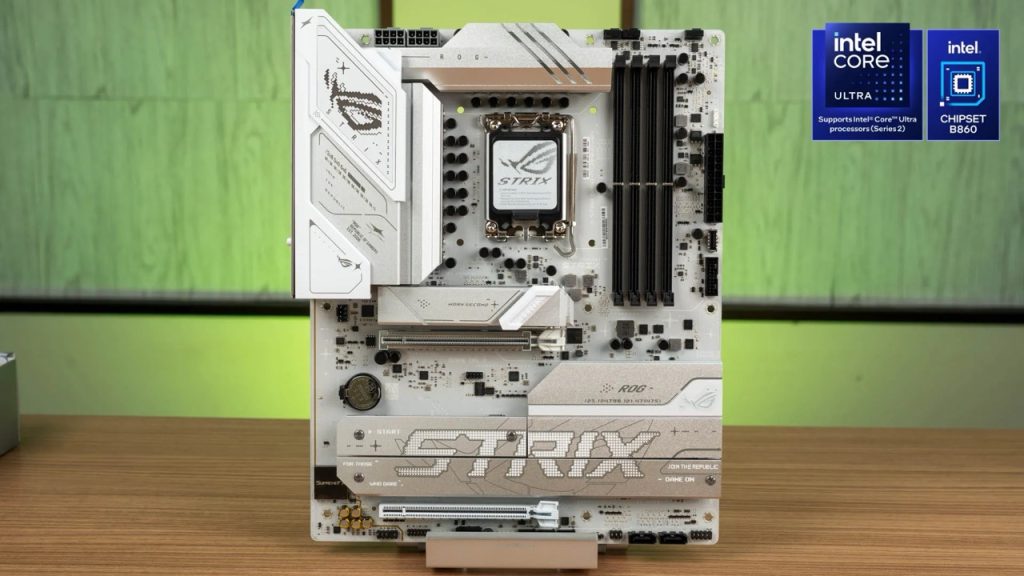
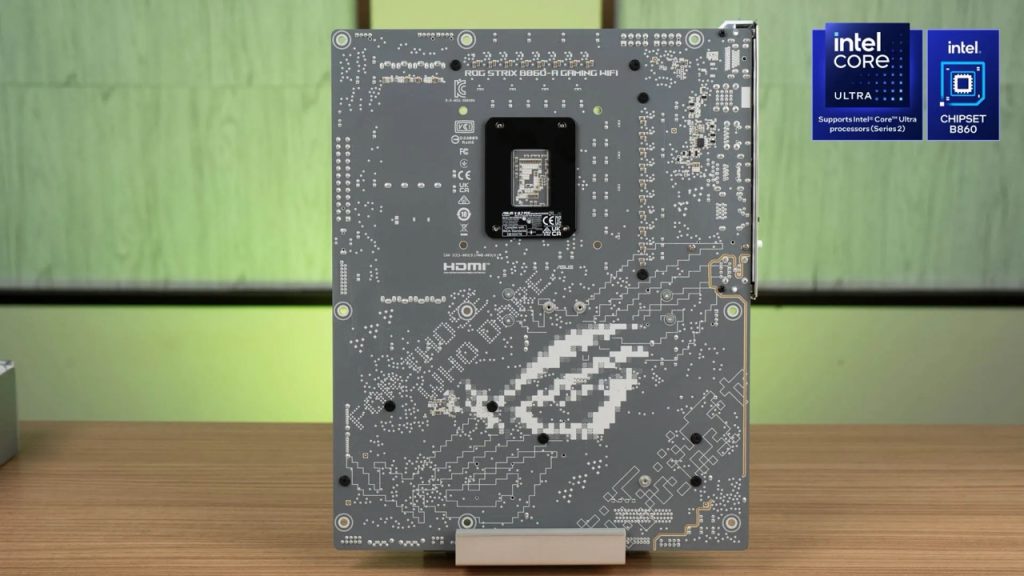
At first glance, the B860-A Gaming WiFi hints at the Z790 Apex and Z890 Apex due to its sleek white-colored PCB. The layout has undergone noticeable changes, with all the M.2 slots now repositioned between the PCIe X16_1 (Gen5) and X16_2 (Gen4) slots, offering a cleaner and more streamlined appearance. Interestingly, ASUS has opted to omit the PCIe X1 slot that was present on the B760-A Gaming WiFi, which might reflect a shift in priorities toward modern expansion needs.
What caught my attention here is that the motherboard goes beyond its eye-catching design by offering a handful of quality-of-life features typically found on higher-end models. Convenience-oriented additions like M.2 Q-Release, M.2 Q-Slide, M.2 Q-Latch, and Q-Release Slim make installation and maintenance significantly easier, positioning this board as an excellent choice for mainstream builders. ASUS deserves praise for incorporating these thoughtful features into a mid-range board, as they elevate the user experience while maintaining an affordable price point.
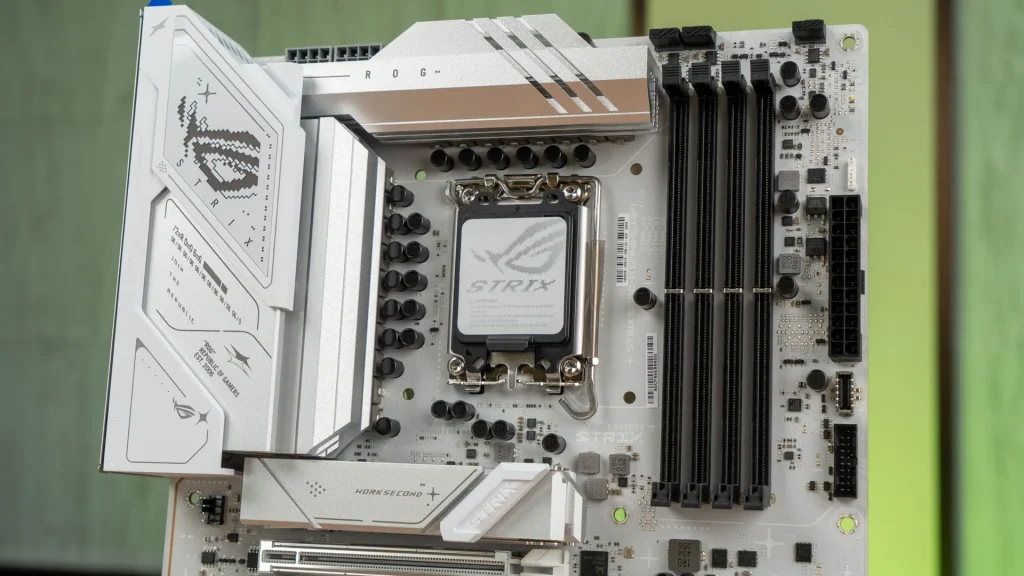
For the power design, specific details remain unclear as the part number labels on the MOSFETs couldn’t be identified, apart from the use of the DIGI+ ASP2442 controller. Based on its configuration, the B860-A Gaming WiFi is presumed to have a 14+2+2 VRM setup, which should be sufficient for handling Core Ultra 5 CPUs that most mainstream users are likely to choose when transitioning to the new platform. This assumption will be revisited once more information becomes available.
Regarding memory, the board features four DIMM slots, supporting up to 192GB of DDR5 RAM. While Intel B-series motherboards like the B860 are designed for mainstream users and have locked CPU overclocking capabilities, memory overclocking remains available. ASUS has further extended DDR5 support on this board to DDR5-9066+, though it’s unclear whether this can be achieved using standard DIMMs or the newer CUDIMMs. Achieving these speeds also depends on the CPU’s memory controller, which is often subject to variability due to the silicon lottery.


Moving on to the storage options and expansion slots, ASUS has opted to exclude the PCIe x1 slot on the B860-A Gaming WiFi, a design choice also reflected in its AMD counterpart. Instead, the board features two PCIe x16 slots: the primary slot operates at PCIe Gen5 speeds, while the secondary slot supports PCIe Gen4. Although the absence of a PCIe x1 slot may be inconvenient for users with expansion cards requiring this interface, the PCIe x16_2 slot can still accommodate these cards. However, it’s important to note that the PCIe x16_2 slot shares bandwidth with the M.2_4 slot, which will be disabled if the PCIe x16_2 slot is in use.
The motherboard offers four M.2 slots, providing ample options for users planning to transition entirely to M.2 SSDs and forgo traditional mechanical hard drives. If the PCIe x16_2 slot is not in use, all four M.2 slots can be utilized, else it’ll be the M.2_1, M.2_2, and M.2_3 only. For those who still require SATA drives, the board includes two SATA ports discreetly located beneath the chipset heatsink, hidden from the top view.

The rear I/O on the B860-A Gaming WiFi shares many similarities with the B760-A Gaming WiFi but comes with a notable improvement in the layout of its USB ports. The USB Type-C ports are now conveniently placed side by side, addressing the awkward positioning seen in the previous design. The placement of the CMOS clear and BIOS flashback buttons is also practical, with ample clearance around them, reducing the risk of accidental presses.
Noteworthy features such as the Q-Antenna and the inclusion of four USB 3.2 Gen1 ports remain a welcome addition. However, when directly compared to its AMD counterpart, the B850-A Gaming WiFi—which was also announced today—the B850-A has the edge if your priority is having more USB 3.2 Gen1 ports. While the B860-A provides sufficient connectivity for most use cases, especially with its four USB 2.0 ports for peripherals like keyboards, mice, microphones, and webcams, the difference in USB 3.2 port count may be a deciding factor for those who rely heavily on higher-speed devices.
In terms of networking, the B860-A Gaming WiFi excels with its 2.5GbE Ethernet port and support for WiFi 7. These features deliver fast, stable, and reliable connectivity, catering to the needs of both mainstream users and more advanced setups requiring robust networking capabilities. Overall, the board strikes a balance between functionality and practicality while offering enhancements over its predecessor.

That concludes our initial impressions of the ASUS ROG Strix B860-A Gaming WiFi. The motherboard shows promise with its thoughtful design and impressive features, making it a strong contender in its segment. Stay tuned as we dive deeper into its performance, conduct detailed testing, and explore a full teardown once the review embargo lifts.